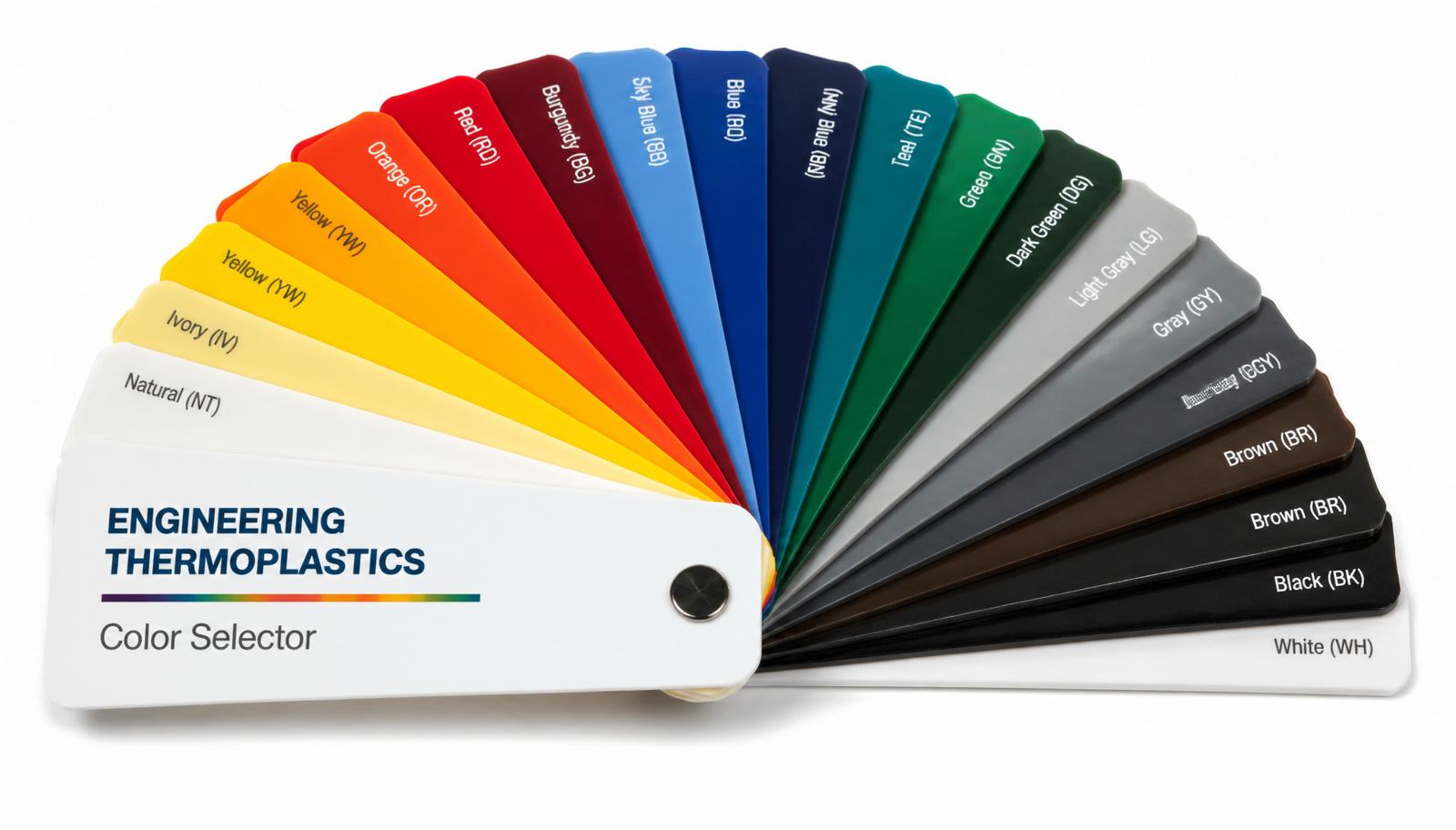
ABS, polycarbonate, polyamide, PBT, PEI, TPE and polyolefins. Short definitions, property tables, typical applications and answers to the questions most often asked by designers and process engineers.
ABS (acrylonitrile-butadiene-styrene) is an amorphous thermoplastic combining stiffness and impact resistance — most commonly used for electronics housings, home appliances and automotive components.
ABS is produced by polymerising three monomers: acrylonitrile (chemical resistance, stiffness), butadiene (impact strength) and styrene (processability, gloss). It moulds very well by injection, can be painted, electroplated and solvent-bonded (MEK, acetone). It is not UV-resistant without stabilisation — for outdoor applications ASA or PC+ASA is preferred.
Technical properties
Density1.03–1.07 g/cm³
HDT (1.8 MPa)85–100 °C
Notched Izod impact200–400 J/m
MFR (220 °C / 10 kg)10–40 g/10 min
Flammability UL94HB (standard), V-0 (FR grades)
Typical applications
—Housings for appliances and consumer electronics
—Vents, dashboards, automotive interior parts
—Toys (including construction bricks)
—Suitcases, helmets, sports equipment
Brands in our portfolio
—CYCOLAC™ (in the portfolio of NexPoint Materials)
Standard ABS is UL94 HB — it burns slowly. For electrical applications, flame-retardant V-0 grades are available.
Can ABS be welded and glued?
Yes. ABS can be ultrasonically, vibration and hot-air welded. It bonds effectively with solvents (MEK, acetone) as well as cyanoacrylate and epoxy adhesives.
Is ABS safe for health?
ABS is chemically stable and does not release bisphenol A. For food contact, dedicated grades compliant with EU 10/2011 are required.
polycarbonate (engineering)
PC
Polycarbonate (PC) is a transparent engineering plastic with exceptional impact strength and heat resistance — used in optics, electronics and safety.
We refer here to engineering polycarbonate for injection moulding — not multiwall sheets for roofing. PC combines near-glass transparency with impact strength up to 250× higher. It is notch-sensitive, susceptible to polar solvents and internal stresses. It is often blended into PC+ABS, PC+ASA, PC+PBT.
Technical properties
Density1.20 g/cm³
HDT (1.8 MPa)125–140 °C
Notched Izod impact600–900 J/m
Light transmissionup to 89%
Flammability UL94HB standard, V-2, V-0, 5VB and 5VA for FR
Typical applications
—Lighting diffusers, LED lenses
—Electronic housings, connectors, sockets
—Ballistic glazing, machine guards
—Sterilisable medical products
Brands in our portfolio
—LEXAN™ (in the portfolio of NexPoint Materials and SABIC)
PC has significantly higher impact strength (practically unbreakable) and better heat resistance, but poorer scratch and UV resistance. PMMA is more transparent and UV-resistant, but brittle.
Can polycarbonate be sterilised?
Yes — medical grades withstand steam, ethylene oxide and gamma sterilisation for a limited number of cycles.
polycarbonate blends
PC+ABS / PC+ASA
PC+ABS and PC+ASA blends combine polycarbonate's stiffness and heat resistance with ABS/ASA's impact strength and processability — the standard for appliance, IT and automotive interior parts.
PC+ABS is the classic blend for housings requiring low-temperature impact strength. PC+ASA additionally brings UV resistance — ideal for automotive exterior parts (mirrors, trims, grilles). Halogen-free flame-retardant (V-0) grades are now the electronics standard.
Technical properties
Density1.12–1.20 g/cm³
HDT (1.8 MPa)100–125 °C
Notched Izod impact500–650 J/m
Flammability UL94V-0 (FR grades)
Typical applications
—Laptop, monitor and printer housings
—Automotive interior and exterior parts
—Appliance and medical device housings
Brands in our portfolio
—CYCOLOY™ (PC+ABS, in the portfolio of SABIC and NexPoint Materials)
—GELOY™ (PC+ASA, in the portfolio of NexPoint Materials)
PC+ABS is cheaper, easier to process and more impact-resistant at low temperatures. Pure PC is chosen when transparency or maximum heat resistance is required.
polyamide (nylon)
PA 6 / PA 6.6
Polyamide (PA, commonly nylon) is a semi-crystalline engineering plastic with high mechanical strength, wear resistance and good chemical resistance — a core material for machine parts and under-hood automotive components.
PA 6 and PA 6.6 differ in chain structure: PA 6.6 has a higher melting temperature (~265 °C vs ~220 °C), greater stiffness and better thermal stability. PA 6 is easier to process, dampens vibrations better and has higher impact strength. Both materials absorb water — this changes their dimensions and mechanical properties, so critical parts use dried and conditioned grades. Glass-fibre reinforcement (GF30, GF50) dramatically increases stiffness and HDT.
Technical properties
Density (unreinforced)1.13–1.15 g/cm³
Tm PA 6 / PA 6.6220 °C / 265 °C
HDT GF30 (1.8 MPa)200–250 °C
Water absorption (24 h)1.2–1.9%
Typical applications
—Gears, plain bearings, cams
—Power-tool housings
—Under-hood components (manifolds, covers)
—Cable ties, connectors
Brands in our portfolio
—Vydyne® (PA 6.6, Ascend Performance Materials)
—POLIMID A (PA 6.6, Poliblend)
—POLIMID B (PA 6, Poliblend)
—POLIMID C (PA 6/PA 6.6 copolymer, Poliblend)
—SECOMID (PA 6 / PA 6.6 from recyclate, Poliblend)
Polyamide (nylon) has higher mechanical strength and wear resistance, but absorbs moisture. Polyester (PET, PBT) is stiffer, dimensionally more stable and less absorbent — but more brittle.
What does PA6 GF30 mean?
Polyamide 6 reinforced with 30% glass fibre. Reinforcement increases stiffness and HDT 2–3×, at the cost of impact strength and shrinkage isotropy.
Can polyamide be used for food contact?
Yes, in grades compliant with EU 10/2011 — e.g. PA 6 is widely used in barrier packaging and kitchenware.
polybutylene terephthalate
PBT / PC+PBT
PBT is a semi-crystalline polyester with high stiffness, dimensional stability and excellent electrical insulation — the standard for automotive connectors and electronics. PC+PBT combines PBT's chemical resistance with PC's impact strength for bumpers and body panels.
PBT melts at ~225 °C, crystallises quickly (short moulding cycles), performs excellently at elevated temperatures and resists fuels and oils. PC+PBT (XENOY) is the classic material for non-flexible car bumpers — combining –40 °C impact resistance with chemical resistance and dimensional stability.
Technical properties
Density PBT1.30–1.35 g/cm³
HDT GF30 (1.8 MPa)200–215 °C
CTI (comparative tracking index)above 600 V
Typical applications
—Connectors, sockets, terminal blocks
—Coils, relay housings
—Bumpers, body panels (PC+PBT)
—Heat-resistant appliance components
Brands in our portfolio
—VALOX™ (PBT, in the portfolio of SABIC and NexPoint Materials)
—XENOY™ (PC+PBT, in the portfolio of NexPoint Materials)
PBT or PA 6.6 — which for an electrical connector?
PBT has better dimensional stability (does not absorb moisture), higher CTI and shorter moulding cycles. PA 6.6 wins when higher impact strength or higher operating temperature is required.
polyetherimide
PEI
PEI (ULTEM) is a high-temperature amorphous plastic with a glass transition of 217 °C, inherent V-0 flammability class and natural transparent honey-coloured appearance — used in aerospace, medical and electronics.
PEI has one of the highest strength profiles among amorphous plastics. It is transparent, with a characteristic natural honey colour. It is inherently flame-retardant (V-0 without additives), meets FAR 25.853 for aircraft interiors, and withstands repeated steam autoclave sterilisation (over 1000 cycles). Its high price limits use to demanding industries.
NORYL (PPO+PS) and NORYL GTX (PPO+PA) are amorphous and semi-crystalline blends with exceptionally low water absorption, dimensional stability and electrical insulation properties — used in automotive, energy and water systems.
PPO+PS (NORYL) combines dimensional stability and dielectric properties with easy processability. PPO+PA (NORYL GTX) is chemically resistant and suitable for online painting — hence its use in fenders and body panels. Low water absorption (~0.1%) sets this family apart from other engineering plastics.
Technical properties
Density1.06–1.10 g/cm³
HDT (1.8 MPa)100–175 °C
Water absorption (24 h)0.05–0.1%
Typical applications
—Pump housings, water fittings (potable water approvals)
TPE-O (polyolefin-based) and TPE-S (styrene-based) are thermoplastic elastomers — combining the elasticity of rubber with the processability of thermoplastics (injection, extrusion, recyclable).
TPEs allow vulcanised rubber to be replaced where short cycle time, recyclability and easy colouring matter. TPE-S (SEBS, SBS) provides soft-touch grippy surfaces (tool handles, brushes). TPE-O offers better chemical resistance and lower cost — typically used for automotive seals. Hardness: from ~20 Shore A to ~70 Shore D.
TPE wins with short production cycles, overmoulding on rigid plastic and recyclability. EPDM rubber still has the edge at very high service temperatures (>150 °C) and long-term UV/ozone resistance.
polyolefins
PE / PP
Polyethylene (PE) and polypropylene (PP) are the most common thermoplastics — lightweight, chemically resistant, easy to process, and the backbone of packaging, pipes, appliance parts and composites.
PE comes in variants: HDPE (rigid, bottles, pipes), LDPE and LLDPE (films). PP is stiffer than PE, withstands higher temperatures (up to ~100 °C), and has excellent flex-fatigue resistance (living hinges). Both materials are inexpensive and fully recyclable.
Technical properties
Density PE / PP0.91–0.96 / 0.90 g/cm³
Tm PE / PP120–135 / 160–170 °C
Water absorptionbelow 0.01%
Typical applications
—Food and cosmetic packaging
—Water and sewage pipes
—Appliance components, car batteries (PP)
—Films, bags, tapes
Brands in our portfolio
—Standard and specialty PE and PP grades in the Danje-Polymer portfolio
Processing aids for plastics — mould release agents, cleaners, lubricants and preservatives from Chem-Trend and Lusin — directly influence part quality and tool life.
The Lusin line (Chem-Trend) includes: mould cleaners (Lusin Clean), release agents (Lusin Alro), lubricants for levers, guides and ejectors (Lusin Lub), preservatives for long tool storage (Lusin Protect), and purging compounds for injection and extrusion screws. Systematic use of Lusin products shortens downtime, reduces scrap and extends mould life several-fold.
MFR / MVRMelt Flow Rate / Volume Rate — a measure of molten plastic flow. Higher values mean easier processing but lower molecular weight.
HDTHeat Deflection Temperature under load (typically 0.45 or 1.8 MPa). A practical measure of heat resistance.
Tg / TmGlass transition temperature (Tg) and melting temperature (Tm). Tg applies to amorphous plastics, Tm to crystalline ones.
UL94Plastics flammability standard. Classes from HB (weakest) through V-2, V-1 to V-0 (self-extinguishing within 10 s, no flaming drips).
Izod / CharpyImpact test methods (J/m or kJ/m²). Notched specimens are stricter — they reflect the effect of stress concentrators.
GF30, GF50Glass-fibre reinforcement 30% or 50% by weight. Increases stiffness and HDT, reduces impact strength and causes anisotropic shrinkage.
CTIComparative Tracking Index — insulating surface resistance to creeping current paths under voltage. Key for electrical connectors.
FRFlame Retardant — flame-retardant grade. Increasingly available in non-halogen (NH) variants — free of chlorine and bromine.
Frequently asked questions
FAQ
How do engineering plastics differ from standard ones?
Engineering plastics (ABS, PC, PA, PBT, POM, PEI) have higher mechanical, thermal and dimensional performance than standard plastics (PE, PP, PS, PVC). They are used where the part serves a technical function — carries loads, operates at elevated temperature or must maintain dimensional precision.
How to choose a plastic for electronics housings?
The most common choices are PC+ABS V-0 (compromise of impact strength, cost and flammability), ABS V-0 (cheaper, less heat-resistant) or PC V-0 (when transparency is needed). For outdoor UV-exposed parts — PC+ASA. For high temperatures (>120 °C) — PEI or PPO.
What does V-0 mean?
The highest UL94 flammability class — after flame removal, the specimen self-extinguishes within 10 seconds, does not drip flaming particles and does not burn to the clamp. Required for most electrotechnical housings.
Can polyamide be used for food contact?
Yes, in grades certified to EU 10/2011 or FDA. PA 6 and PA 6.6 are widely used in barrier film for meat and cheese packaging and in small kitchen equipment.
What does GF30 mean?
30% glass-fibre reinforcement. Stiffness and strength rise 2–3×, HDT climbs 60–100 °C, but impact strength drops and shrinkage becomes anisotropic (different along and across the fibres).
Not sure which plastic to choose?
Our engineering team will help you select the right material for your specific application — from samples through processing trials to serial roll-out.